Every growing business eventually faces the same question: where should our technology actually live?
It's not a simple decision. Your finance director is calculating capital expenditure. Your operations team needs reliability. Your IT manager is thinking about scalability. And everyone's watching the bottom line.
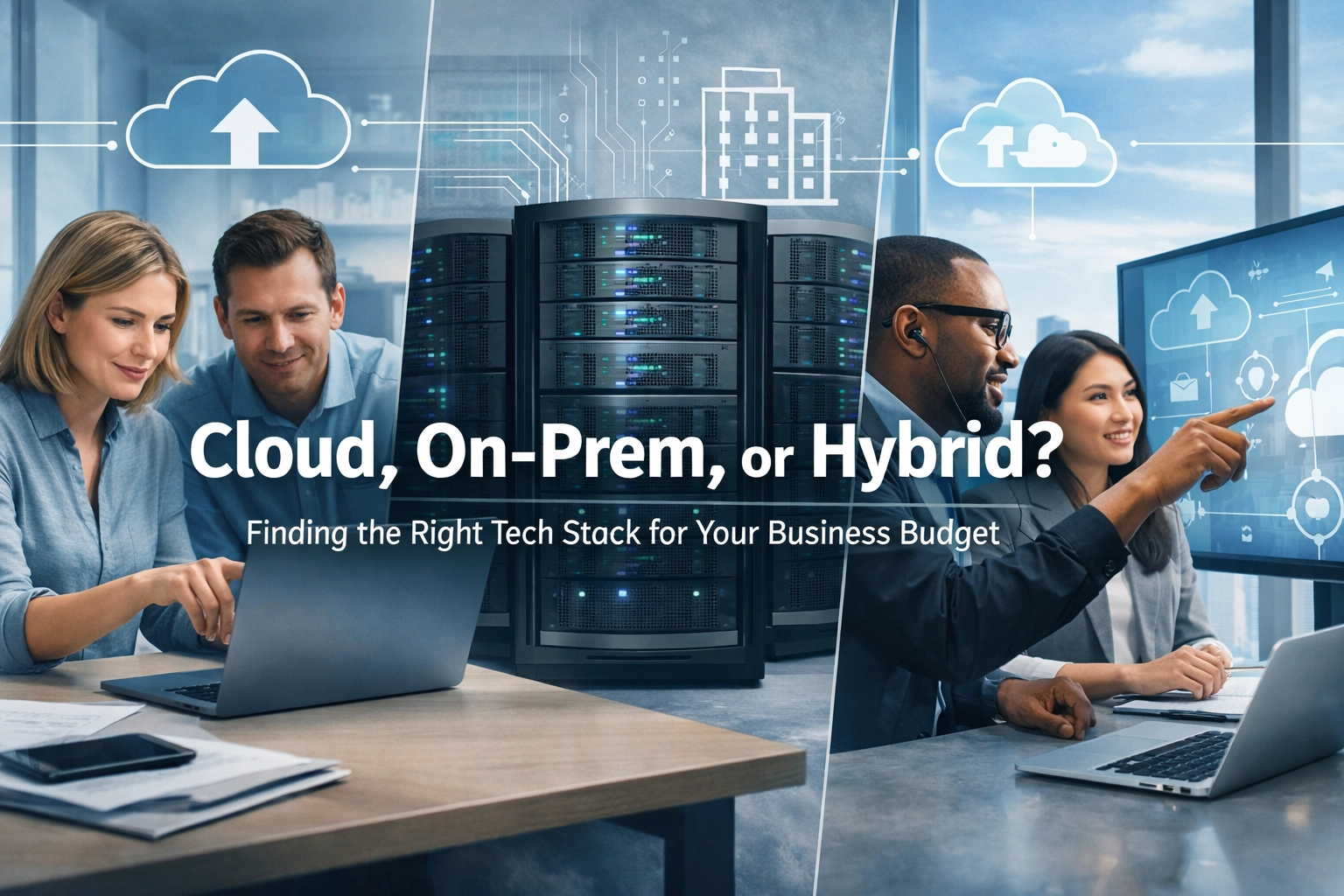
The truth is, there's no universal answer. Cloud, on-premises, and hybrid infrastructures each have their place: but only when they match your actual business needs and budget realities. Let's cut through the marketing noise and look at what actually makes sense for your organisation.
Understanding Your Three Options
On-Premises Infrastructure means your servers, storage, and networking equipment sit in your building or a dedicated data centre you control. You own the hardware, manage the maintenance, and handle the upgrades. Think of it as owning your home: high upfront cost, but you control everything.
Cloud Infrastructure shifts your IT resources to providers like Microsoft Azure, AWS, or Google Cloud. You access computing power, storage, and applications over the internet on a subscription basis. It's like renting: lower entry cost, but you're paying monthly indefinitely.
Hybrid Infrastructure splits the difference. You keep certain systems on-premises while moving others to the cloud, creating a technology environment that bridges both worlds. Many organisations find this the most practical approach, though it requires careful planning to execute properly.

The Real Cost Equation
When business owners compare infrastructure costs, they often focus on the wrong numbers. The sticker price is only part of the story.
On-premises infrastructure demands significant capital expenditure upfront. You're buying physical servers, networking equipment, storage arrays, and backup systems. For a mid-sized business, this can easily run £50,000–£150,000 before you've even switched anything on. Then there's the ongoing cost of power, cooling, physical space, and maintenance contracts.
Here's what catches people off guard: those costs are largely fixed and predictable. Once you've made the investment, your monthly operational costs remain relatively stable. For businesses with consistent, predictable workloads, this model often proves more cost-effective over a 3–5 year period than continuously paying cloud subscriptions.
Cloud infrastructure flips the model. Minimal upfront investment: sometimes just the first month's subscription. Your IT environment can be operational within hours rather than weeks. For businesses without £100,000 sitting around for infrastructure investment, this accessibility is transformative.
The catch? Those monthly costs compound. A £2,000 monthly cloud bill becomes £24,000 annually, £72,000 over three years, £120,000 over five years: and you still don't own anything. Cloud costs also tend to creep upward as your usage grows, sometimes in ways that surprise finance teams.
Hybrid infrastructure requires both upfront investment and ongoing cloud costs, but strategic placement can optimise total expenditure. Keep your stable, baseline workloads on-premises where long-term costs are lower. Use cloud resources for variable demand, testing environments, or disaster recovery where flexibility outweighs ownership.

Matching Infrastructure to Workload Reality
The most expensive infrastructure decision is choosing based on what's trendy rather than what fits your actual business operations.
On-premises makes sense when:
- Your workloads are predictable and stable month-to-month
- You handle sensitive data subject to strict compliance requirements (financial services, healthcare, legal)
- You need consistent, ultra-low latency for mission-critical applications
- You plan to use systems for 5+ years without major changes
- You have existing IT staff who can manage physical infrastructure
Schools and educational institutions often benefit from on-premises core infrastructure. Student data requires careful control, term-time demand is highly predictable, and budgets favour capital investment over perpetual subscriptions. At Anantek Solutions, we've designed robust on-premises networks for educational clients that deliver reliable performance year after year: the kind of "Tech That Lasts" that makes financial sense over the long term.
Cloud infrastructure excels when:
- Your business experiences significant seasonal or variable demand
- You need to scale rapidly without infrastructure delays
- Capital expenditure is constrained but operational budget exists
- You're running modern, cloud-native applications
- Geographic distribution matters: you need resources closer to customers worldwide
Fit-out companies, for example, often benefit from cloud-based project management and collaboration tools that scale up during busy periods and scale down when projects complete. The flexibility matches the project-based nature of the work.
Hybrid infrastructure works best when:
- You have both stable baseline systems and variable workloads
- Compliance requires certain data to stay on-premises
- You want disaster recovery flexibility
- You're gradually modernising legacy systems
- You need the security of ownership with the elasticity of cloud
Most organisations eventually land here. Keep your core business systems, sensitive databases, and infrastructure backbone on-premises where you control them completely. Use cloud resources for customer-facing applications, development environments, and workload bursting during peak periods.

The Longevity and Scalability Question
"Tech That Lasts" isn't just about choosing durable hardware: it's about building infrastructure that grows with your business without requiring a complete rebuild every few years.
On-premises infrastructure scales vertically: you add more powerful servers, additional storage, faster networking equipment. This works brilliantly until you hit the limits of what your physical space and power supply can handle. Scaling requires planning, budget approval, procurement, installation, and configuration. You're looking at weeks or months for significant expansion.
Cloud infrastructure scales horizontally with a few clicks. Need more computing power for month-end processing? Spin up additional virtual machines. Launching a new service? Deploy globally in minutes. That elasticity is genuinely valuable for businesses experiencing rapid growth or unpredictable demand.
The hybrid approach offers strategic scalability. Your on-premises infrastructure handles baseline requirements with room for steady, planned growth. When you need to burst beyond that capacity: seasonal trading, special projects, market expansion: cloud resources provide instant elasticity without overbuilding your physical infrastructure.
Infrastructure Management: The Hidden Differentiator
Here's what infrastructure vendors rarely discuss: the ongoing management burden.
On-premises infrastructure requires active management. Firmware updates, security patches, hardware monitoring, backup verification, disaster recovery testing: it never stops. If you have skilled IT staff, this is manageable. If you're relying on "whoever knows computers," you're building on shaky ground.
Cloud infrastructure shifts management responsibilities to the provider, but that doesn't mean it manages itself. You still need expertise to configure services properly, manage costs effectively, implement security correctly, and integrate systems seamlessly. Poor cloud architecture leads to budget blowouts and security gaps just as surely as neglected on-premises equipment leads to downtime.
Hybrid infrastructure doubles the management complexity unless you have a partner who understands both environments. You need someone who can design the integration, manage the connectivity, maintain security across both domains, and optimise costs continuously.
This is where working with an experienced IT infrastructure partner makes the financial difference. We've guided businesses through infrastructure decisions for years: not to sell a particular model, but to find what actually fits your operations and budget. Whether you need structured cabling for on-premises networking, cloud migration planning, or hybrid architecture design, the goal remains the same: infrastructure that works reliably without constant crisis management.
Making Your Decision: A Practical Framework
Stop thinking about cloud versus on-premises as an either-or choice. Start with these questions:
1. What's your actual workload pattern? Track your computing, storage, and network usage for three months. If it's relatively flat, on-premises economics likely favour you. If it fluctuates significantly, cloud flexibility becomes more valuable.
2. What's your capital position? Be honest about what you can invest upfront versus commit to monthly. Remember that "affordable monthly payments" compound quickly over time.
3. What are your compliance requirements? Some regulations effectively require on-premises infrastructure for certain data. Don't fight this: design around it with a hybrid approach if needed.
4. What's your technical capability? If you have skilled IT staff or a trusted managed services partner, on-premises infrastructure is viable. If you're stretched thin, cloud's managed services reduce operational burden.
5. What's your growth trajectory? Stable, predictable growth suits on-premises planning. Rapid, uncertain growth benefits from cloud elasticity.
For most SMEs, the answer is hybrid. Keep mission-critical systems, sensitive data, and core infrastructure on-premises where you control them completely. Use cloud services for collaboration tools, customer-facing applications, and capacity expansion. Get expert help designing the integration so both environments work together seamlessly rather than creating management headaches.
At Anantek Solutions, we approach infrastructure as a long-term partnership rather than a one-time sale. Whether that means designing resilient on-premises networks with structured cabling and dedicated equipment, architecting cloud migrations, or building hybrid environments that give you the best of both worlds: the goal is always technology that serves your business reliably and economically for years to come.
Your infrastructure should be invisible when it's working properly and built to last when it counts. That starts with choosing the right model for your actual needs, not the latest trend.