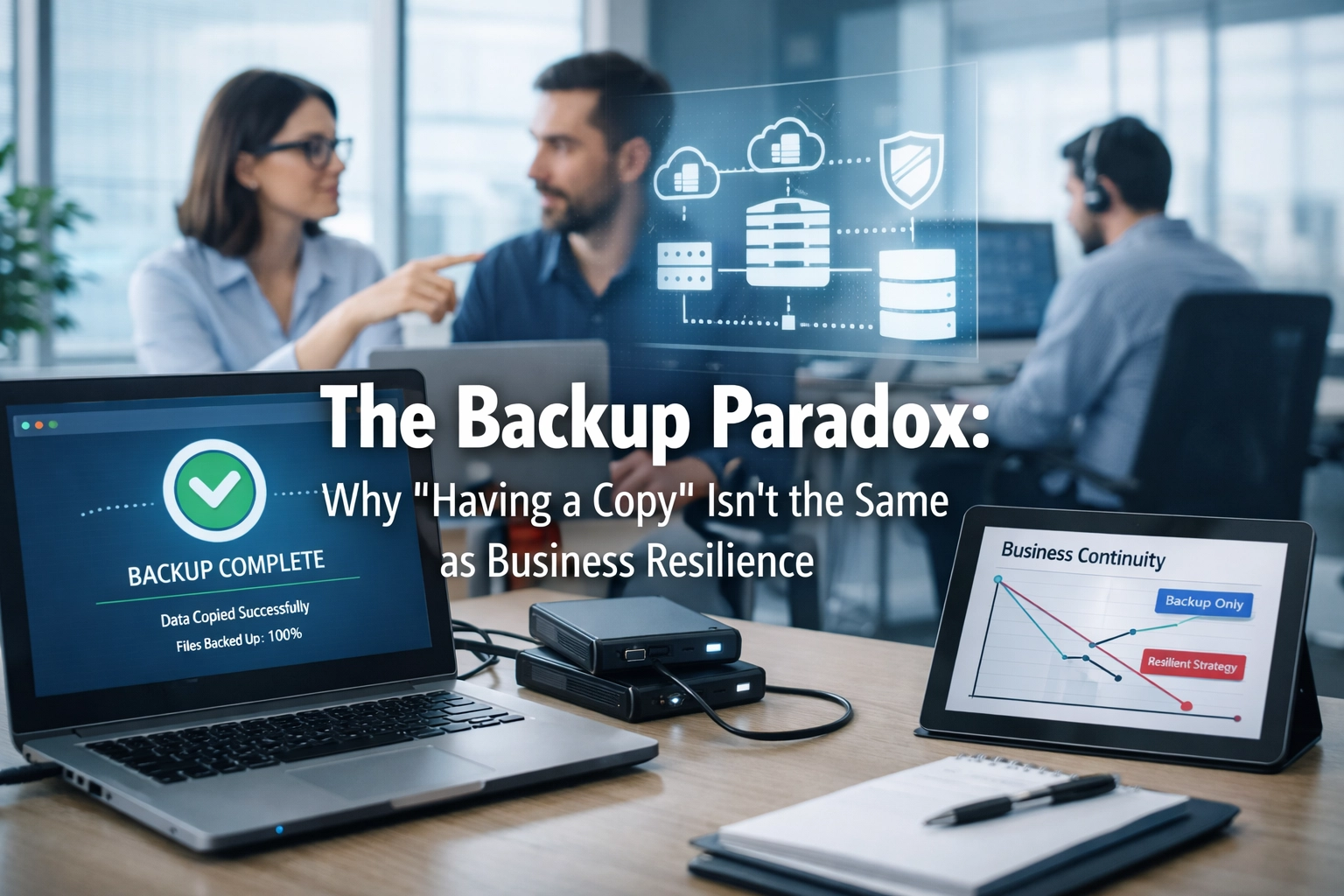
In the world of IT management, there is a dangerous comfort found in the phrase: "Don't worry, we have a backup."
For many IT Directors and Operations Leads, this sentence is treated as a universal shield against disaster. However, at Anantek Solutions, we often encounter what we call the Backup Paradox. This is the phenomenon where an organisation meticulously saves copies of its data, yet remains completely unable to function during a crisis.
Having a copy of your data is a technical task; achieving business resilience is a strategic outcome. As we move further into 2026, the gap between these two concepts is widening. If your strategy stops at "having a copy," you aren't prepared for a recovery: you’re just documenting your own downtime.
Understanding the Paradox: Data vs. Availability
The paradox lies in the false sense of security that a successful backup log provides. You see a "Green Tick" on your dashboard every morning, but that tick only confirms that data was moved from Point A to Point B. It does not guarantee that:
- The data is uncorrupted or free from dormant ransomware.
- The hardware required to run that data is available.
- The network infrastructure is capable of handling the restoration speed required.
- Your team knows the sequence of operations to bring systems back online in the right order.
True business resilience is the ability to absorb a shock, maintain critical functionality, and restore normal operations with minimal friction. It is the difference between having the ingredients for a meal stored in a locker ten miles away and having a working kitchen ready to serve.

Backup vs. Resilience: The Strategic Divide
To build what we call "Invisible Infrastructure": tech that works so reliably it becomes part of the furniture: you must understand the hierarchy of protection.
1. The Backup (The Foundation)
This is the baseline. It is the process of creating a point-in-time copy of data. It protects against accidental deletion or localized hardware failure. However, backups are often "cold." They take time to move and time to re-integrate.
2. Business Continuity (The Process)
This involves the plans and logistics required to keep the lights on. If your primary server room in London suffers a power failure, how do your staff in Surrey continue to work? Business continuity focuses on the "how" of maintaining operations during the restoration phase.
3. Business Resilience (The Outcome)
Resilience is a holistic state. It combines robust it-infrastructure with proactive detection and rapid recovery. A resilient business doesn't just survive an outage; it thrives because its systems are designed for high availability and "Improved Longevity."
The Metrics That Matter: RTO and RPO for SMEs
For any CTO or Operations Lead, the conversation about resilience must be grounded in two metrics: Recovery Time Objective (RTO) and Recovery Point Objective (RPO).
- RPO (Recovery Point Objective): This defines how much data you can afford to lose. If you back up once every 24 hours, your RPO is 24 hours. For a high-end retail environment or a school’s administrative system, losing a full day of data can be catastrophic.
- RTO (Recovery Time Objective): This is the "downtime" clock. How long does it take from the moment of failure until the business is operational again?
The Backup Paradox often reveals itself here. An SME might have a great RPO (they back up every hour) but a terrible RTO (it takes three days to download that data and configure a new server). In a world of "Tech That Lasts," we aim to shrink both of these numbers through intelligent it-management.

The 3-2-1-1 Strategy: Modernising the Gold Standard
Most IT professionals are familiar with the 3-2-1 rule: three copies of data, on two different media, with one copy offsite. At Anantek, we advocate for the 3-2-1-1 strategy to combat modern threats like ransomware.
- 3 Copies of Data: The original and two backups.
- 2 Different Media: E.g., Cloud storage and local NAS.
- 1 Offsite: Protection against physical disasters (fire, flood).
- 1 Immutable/Air-Gapped: A copy that cannot be changed or deleted, even by an admin account. This is the ultimate "Unparalleled Security" measure against cyber-attacks.
For fit-out companies and large-scale infrastructure projects, this level of redundancy is essential. When we design networks for luxury brands like Audemars Piguet (AP) and A. Lange & Söhne (ALS), we don't just think about the Wi-Fi signal; we think about the resilience of the entire digital ecosystem. If the structured cabling is the nervous system, the resilient backup strategy is the immune system.
Why Testing is Non-Negotiable
A backup that hasn't been tested isn't a backup: it's a wish.
We recently discussed this in our SME IT Resilience Checklist. Many organisations fail to recover because they never practiced. Restoration is a high-pressure event. If your first time running a full system restore is during a real crisis, you are significantly more likely to encounter configuration errors or hardware bottlenecks.
We recommend "Fire Drill" restoration tests. This isn't just checking if a single file can be recovered. It’s a full-scale test:
- Can we spin up a virtualised environment in the cloud?
- Does the london-it-service team have the access keys needed?
- Is the network bandwidth sufficient for the data transfer?

The Infrastructure Perspective: Beyond the Software
True resilience is baked into the physical layer. This is why Anantek Solutions focuses heavily on the integration of IT services with physical security and robust networking.
For schools and office fit-outs, resilience includes:
- Structured Cabling: Ensuring there are no single points of failure in the physical network.
- UPS (Uninterruptible Power Supplies): Protecting hardware from the "hard shutdowns" that often corrupt backup databases.
- CCTV and Access Control: Integrating these into the IT environment ensures that physical security and digital data are protected under a single, resilient umbrella.
When we partner with "trusted electrical partners" on high-end fit-outs, we ensure that the "Invisible Infrastructure" is installed to a standard that supports rapid recovery. Our work with luxury watch brands like AP and ALS proves that when precision is required, the underlying IT must be equally flawless.
Building Resilience with Anantek Solutions
At Anantek, we don't just sell software licenses; we act as a Trusted Partner. Our goal is to move you away from the Backup Paradox and toward a state of total business resilience.
We look at your packages not as a list of features, but as a roadmap to business continuity. Whether it's through exceptional-it-optimisation or managed security, we ensure that your "Tech Lasts" and your business stays online, regardless of the challenges the world throws at it.
The Backup Paradox is a choice. You can choose the comfort of a green tick on a screen, or you can choose the certainty of a resilient infrastructure.
Is Your Business Truly Resilient?
Don't wait for a crisis to find out that your backups are just "copies." Ensure your recovery is fast, your data is secure, and your infrastructure is invisible.
Contact Anantek Solutions for a Resilience Audit today and let’s ensure your business is built to last.